Your voicemail greeting is a recording of your voice, and a scammer needs only a short audio clip of a family member’s voice to fake a panicked call from a grandchild in jail. This post is about the most overlooked source of that clip: the AI voice clone voicemail greeting. Switch your greeting to the phone’s default greeting, agree on a family safe word, and never send money because of a phone call — hang up and call your loved one back on the number you already have saved.
The call the FTC described in March 2023 goes like this: a panicked voice on the line, your grandson, in deep trouble — he wrecked the car and landed in jail, and you can help by sending money. It sounds just like him. How could it be a scam? Voice cloning, that is how. A scammer could use AI to clone the voice of your loved one. All he needs is a short audio clip of your family member’s voice — which he could get from content posted online — and a voice-cloning program. When the scammer calls you, he will sound just like your loved one.
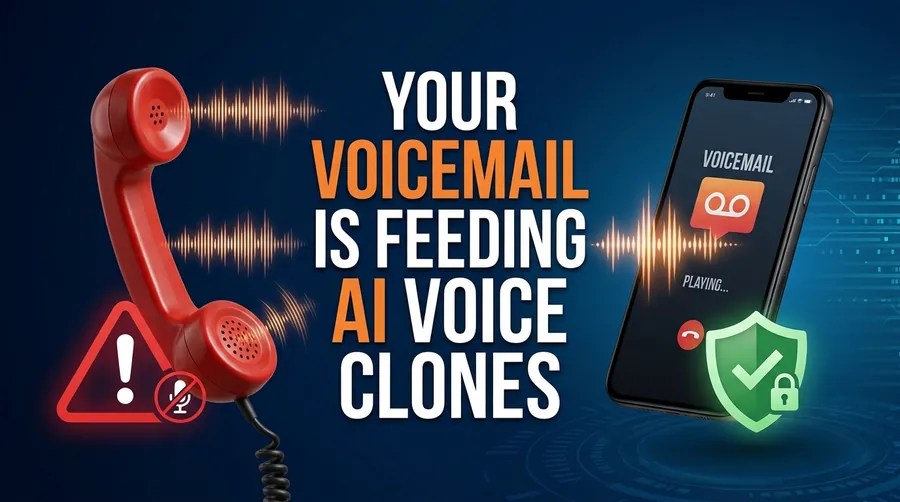
Most people think of social media videos when they hear “content posted online.” But there is a recording of your voice that almost everyone forgets: your voicemail greeting. Anyone who dials your number can hear it — and record it. The same is true of your grandchildren’s greetings. A greeting is usually clear, it usually includes the person’s name, and it is available to any caller, any time, with no password and no friend request. That is why it is the first thing to fix, and it takes about two minutes.
What is an AI voice clone voicemail greeting?
It is not a product or a setting. It is the risk itself: your recorded voicemail greeting, used as the raw material for an AI voice clone. The scammer does not need to hack your phone or steal anything. They dial your number, let it ring through to voicemail, and record the greeting. Then they do the same to your grandchild’s number. A short clip of a voice, plus a voice-cloning program, is enough to make a fake call that sounds like your family member in trouble. The FBI put it plainly in December 2024: criminals generate short audio clips containing a loved one’s voice to impersonate a close relative in a crisis situation, asking for immediate financial assistance or demanding a ransom. That is the whole trick behind an AI voice clone voicemail greeting: nothing is stolen and nothing is hacked — the voice was given away by the greeting itself.
What does the “Grandma, I’m in jail” call sound like?
The grandchild in jail call follows the same pattern almost every time. First, the panicked voice: “Grandma, it’s me. I messed up. I was in an accident and they arrested me. Please don’t tell Mom and Dad.” Then, often, a second voice takes over — someone claiming to be a lawyer, a police officer, or a bail bondsman — who explains the bail and how to pay it. The caller begs you to keep it secret, because secrecy is what stops you from checking. The payment is always in a form that is hard to get back: a wire, cryptocurrency, or gift cards with the numbers and PINs read out over the phone. The FTC says those payment methods are signs of a scam. The amounts and the exact words change from call to call. The pattern does not.
Where does the scammer get your grandchild’s voice?
The grandparent scam AI voice calls need only one thing to work: a short clip of a voice. The FTC says a scammer needs only a short audio clip of a family member’s voice, which he could get from content posted online. That covers a lot of ground, and the greeting is the part of it that nobody guards. Every voice cloning scam starts with a real clip of a real voice, and the greeting is the easiest clip to get.
Social media videos are the obvious source: a birthday video, a graduation post, a livestream, a podcast clip. Anything where your grandchild speaks, in public, is material a scammer can use. The FBI’s advice on this is direct: if possible, limit online content of your image or voice, make social media accounts private, and limit followers to people you know.
Voicemail greetings are the forgotten source. Your greeting says your name, in your voice, clearly, with no background noise — and it plays for anyone who calls, including a stranger who has never met you. Your grandchild’s greeting does the same for them. Unlike a social media video, you cannot make a greeting private. You can only replace it, and the replacement is the phone’s default greeting, which is a recorded voice that is not yours.
How do I switch my voicemail to the default greeting?
Do this now, for your own phone and for your parents’ phones, before the call comes — it closes off the AI voice clone voicemail greeting risk in about two minutes. The exact menu name differs by phone and carrier, so look for “Greeting” in your voicemail settings rather than following one fixed path.
| Step | What to do | Why it works |
|---|---|---|
| 1. Open your voicemail settings | On most phones this is in the Phone app, under Voicemail and then Greeting. On some carriers it is in the carrier’s own voicemail app or in your account settings. | You reach the one place where your recorded voice is stored. |
| 2. Choose “Default” instead of “Custom” | Select the default greeting and save it. The default greeting is a recorded voice that is not yours — it says the person is not available and asks the caller to leave a message. | A scammer who dials your number hears a stranger’s voice, not yours. |
| 3. Do the same for your grandchildren | Ask your grandchildren to switch their greetings too, and to make their social media accounts private. | The voice the scammer wants is usually your grandchild’s, not yours. |
| 4. Check who can hear your voice online | Make social media accounts private and limit followers to people you know, as the FBI advises. | Fewer public clips means less material to clone from. |
If you cannot find the greeting setting, call your carrier and ask them to switch your voicemail to the default greeting. It is a normal request, and it takes a minute.
How do I set up a family safe word in 5 minutes?
The greeting fix removes one source of the voice. The safe word is what stops the call itself. The FBI’s advice is to create a secret word or phrase with your family to verify their identity. Do it tonight, at the dinner table or on a normal call, not during an emergency.
| Step | What to do | Why it works |
|---|---|---|
| 1. Pick a word or short phrase | Something odd and easy to remember, never posted anywhere online. Not a pet’s name, a birthday, a school, or a street name — scammers can find those online. | A clone can copy a voice, but it cannot know a secret that was never said online. |
| 2. Share it in person | Tell parents, grandparents, and grandchildren old enough to travel or drive. Do not post it, text it to a group chat, or save it in a note called “safe word”. | The word only works if it stays inside the family. |
| 3. Agree the rule | Anyone who calls in an emergency and asks for money must say the word first. No word, no money. | The rule removes the need to decide while you are panicking. |
| 4. Practice it once | Call your mom or dad and ask for the word, so the habit is there before it is needed. | A habit you have practiced is one you will use when you are scared. |
| 5. If the word is forgotten | Hang up and call the person back on the number you already have saved. A forgotten word is never a reason to send money. | The call-back is the second lock on the same door. |
Real call vs cloned call — how to tell them apart
| Sign | Real emergency call | Cloned-voice scam call |
|---|---|---|
| The voice | Sounds like your grandchild — and they can answer questions only they would know, including the family safe word. | Sounds like your grandchild too. A clone can sound just like them, so the voice proves nothing on its own. |
| The story | They tell you where they are, and you can check it: the hospital, the police station, a number you look up yourself. | Vague, urgent, and secret: “Don’t tell Mom and Dad.” You are told not to check with anyone. |
| The payment | Nobody asks for money on the call. A real hospital or police station does not collect bail by phone. | Money now, by wire, cryptocurrency, or gift cards — payment methods the FTC says are signs of a scam. |
| The check | You hang up, call them back on the number you already have saved, and they answer. | The caller begs you not to hang up, gives you a different number, or says calling back will make it worse. |
The advice in the FTC’s March 2023 alert is the whole test in one sentence: don’t trust the voice. Call the person who supposedly contacted you and verify the story, using a phone number you know is theirs. If you cannot reach them, try another family member or their friends.
What if I already paid?
Act on the same day, in this order. First, call the company you paid through — your bank, the wire company, or the gift card issuer, using the number on the back of the card — and ask whether the payment can be stopped or reversed. Then call your bank’s fraud line. Then report it: to your local police, to the FTC at ReportFraud.ftc.gov, and to the FBI at ic3.gov. If the person targeted is 60 or older, the National Elder Fraud Hotline (1-833-372-8311, Monday to Friday, 10 a.m. to 6 p.m. Eastern) can walk you through what to do.
There is no guarantee the money will come back. Credit cards have the strongest protections; gift cards, wires, cryptocurrency, and cash handed to a courier are the hardest to recover, which is exactly why scammers ask for them. Do not trust anyone who contacts you offering to get the money back for a fee.
The same trick, with a different voice
This call is one version of a trick that keeps changing its costume. The same urgency, the same secrecy, and the same demand for money show up in other messages too. An AI voice clone scam does not need your password or your bank login. It needs your voice, and your greeting hands it over. If you are the adult child in the family, start with our guide to protecting your parents’ computer, which is the practical setup for a parent who should never have to make a security decision alone. And our guide to the best antivirus for seniors covers the scam calls and popups aimed at older adults, and the three simple picks that stop them. The message changes; the test never does. If an unexpected call demands money, check it yourself through a channel you chose — never through the call.
Frequently asked questions
Can scammers really clone a voice from a voicemail greeting?
A voicemail greeting is a clear recording of a voice, and anyone who dials the number can hear it. The FTC says a scammer needs only a short audio clip of a family member’s voice, which he could get from content posted online, and a voice-cloning program. A greeting is the same kind of material — and it is the one most people never think to change. Switching to the default greeting takes about two minutes and removes it.
Is the “grandchild in jail” call ever real?
A real emergency is possible, which is exactly why the check matters. Hang up and call your grandchild on the number you already have saved. If they answer, safe at home, the call was fake. If you cannot reach them, call their parent or another family member. A real emergency survives a five-minute check; a scam call usually does not.
What is a family safe word, and how do we set one up?
A word or short phrase only your family knows. The FBI’s advice is to create a secret word or phrase with your family to verify their identity. Pick something odd and easy to remember, share it in person, and agree that anyone who calls in an emergency and asks for money must say it first. No word, no money.
What if my grandchild forgets the safe word?
A forgotten word is never a reason to send money. Hang up and call them back on the number you already have saved. If you cannot reach them, call their parent. The safe word is one lock; the call-back is the second.
The call came from my grandchild’s number. Doesn’t that prove it is real?
No. The number on your screen is not proof of who is calling. The FTC’s advice is to call the person back using a phone number you know is theirs — the one already saved in your phone — not the number that just called you.
I already sent money. Can I get it back?
There is no guarantee. Call the company you paid through right away — your bank, the wire company, or the gift card issuer — and ask whether the payment can be stopped or reversed. Then report it to your local police, to the FTC at ReportFraud.ftc.gov, and to the FBI at ic3.gov. If the person targeted is 60 or older, the National Elder Fraud Hotline (1-833-372-8311) can help with the next steps.
Should I delete all my videos and photos from social media?
No. The FBI’s advice is narrower: limit online content of your image or voice, make social media accounts private, and limit followers to people you know. You do not need to delete everything — you need to decide who can hear and see it.
Sources: FTC consumer alert, 20 March 2023, “Scammers use AI to enhance their family emergency schemes”; FBI IC3 public-service announcement I-120324-PSA, 3 December 2024, “Criminals Use Generative Artificial Intelligence to Facilitate Financial Fraud”; FBI IC3 public-service announcement I-012924-PSA, January 2024, “Scammers Use Couriers to Retrieve Cash and Precious Metals from Victims of Tech Support and Government Impersonation Scams”; U.S. Department of Justice, Office for Victims of Crime, National Elder Fraud Hotline.