Based on US Department of Commerce regulatory filings, AV-TEST independent lab data, and security community analysis.
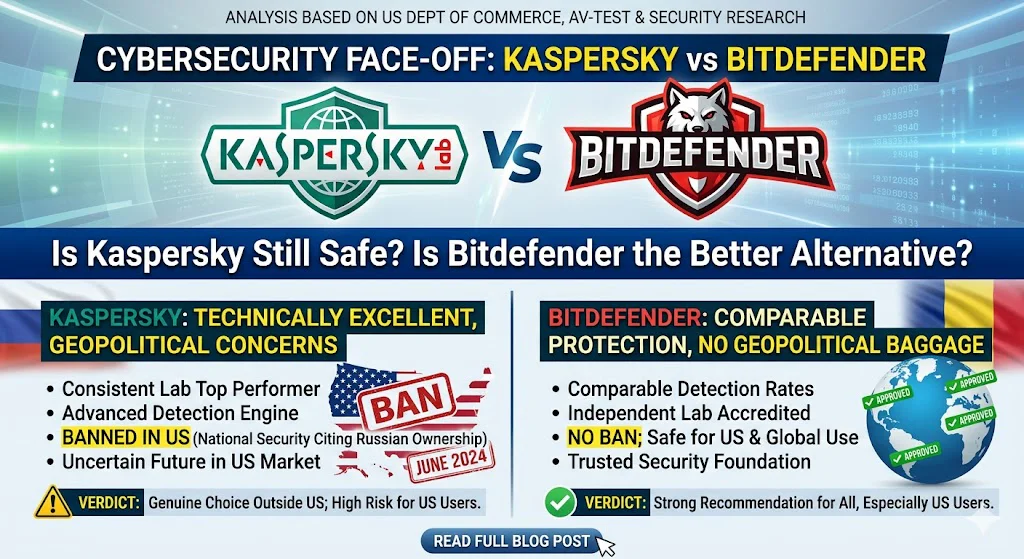
For years, Kaspersky was considered one of the best antivirus products available — consistently topping independent lab tests and praised by security researchers for its detection engine. Then in June 2024, the US Department of Commerce issued a ban on Kaspersky software sales in the United States, citing national security concerns related to Kaspersky’s Russian ownership.
The question this raises for millions of users is straightforward, Kaspersky vs Bitdefender: is Kaspersky still safe to use, and how does it compare to the obvious alternative — Bitdefender, which combines comparable detection rates with none of the geopolitical complications?
The honest answer depends significantly on where you live and what risks matter most to you. This comparison covers both dimensions fairly.
Verdict upfront US users should switch to Bitdefender — Kaspersky software is effectively unavailable for new purchases in the US following the 2024 ban. Users outside the US face a genuine choice: Kaspersky remains a technically excellent product, but the ownership concerns documented by US agencies are worth understanding before deciding. Bitdefender provides comparable detection rates with no geopolitical complications for any user.
The US ban — what actually happened and what it means
⚠️ What the US Department of Commerce found and decided
In June 2024, the US Department of Commerce’s Bureau of Industry and Security (BIS) announced a final rule prohibiting Kaspersky Lab from selling or distributing its cybersecurity software in the United States, effective September 29, 2024. The action was taken under the authority of the International Emergency Economic Powers Act (IEEPA).
The Department’s stated concern was that Kaspersky’s Russian ownership creates a risk that the Russian government could use legal mechanisms to compel Kaspersky to use its privileged access to customer systems to collect sensitive data, disable security software, or install malicious code. Antivirus software by nature requires deep system access — it can read files, intercept network traffic, and modify system processes — making the risk profile of a potentially compromised security tool particularly serious.
Kaspersky denied all allegations of wrongdoing, stated that it operates independently of the Russian government, and noted that its threat intelligence and source code have been made available for independent review through its Transparency Centers. The company subsequently announced the closure of its US operations and the layoff of its US-based employees.
The ban applies to US territory. It does not legally affect Kaspersky users in other countries, though several European governments and organisations had earlier issued their own advisories recommending caution with Kaspersky products.
Detection rates — are they actually different?
Setting aside the geopolitical question for a moment — on pure technical merit, how do the two products compare in independent testing?
| Detection metric | Kaspersky Standard/Plus | Bitdefender Total Security |
|---|---|---|
| Overall malware detection (AV-TEST) | 99.8–100% | 99.8–100% |
| Zero-day malware detection | 99–100% | 99–100% |
| False positive rate | Very low | Very low |
| AV-TEST Protection score | 6/6 consistent | 6/6 consistent |
| AV-Comparatives rating | Advanced+ | Advanced+ |
| Independent lab years tested | 30+ years of data | 20+ years of data |
Both products are at the absolute top tier of independent lab testing. The detection gap between them is negligible — both consistently score at or near 100% across multiple testing cycles. For the vast majority of threats that home users actually encounter, either product provides excellent protection. The choice between them is not meaningfully about detection rates.
System performance comparison
| Performance metric | Kaspersky | Bitdefender |
|---|---|---|
| Idle RAM usage | ~80–120MB | ~65–85MB |
| AV-TEST performance score | 6/6 | 6/6 |
| System impact (AV-TEST) | Minimal | Minimal — slightly lighter |
| Scan speed | Fast | Fast (cloud-assisted) |
| Impact on older PCs | Light | Very light |
Both are considered lightweight by industry standards — significantly lighter than Norton or McAfee. Bitdefender’s cloud-assisted scanning gives it a slight edge in memory footprint on older machines, but the practical difference for most users is minimal. Both score 6/6 in AV-TEST performance testing.
Feature comparison
| Feature | Kaspersky Plus (5 devices) | Bitdefender Total Security (5 devices) |
|---|---|---|
| Real-time malware protection | ✅ Excellent | ✅ Excellent |
| Anti-phishing | ✅ Excellent | ✅ Excellent |
| VPN | ✅ Unlimited included | ⚠️ 200MB/day (paid to unlock) |
| Password manager | ✅ Full-featured | ⚠️ Basic |
| Parental controls | ✅ Kaspersky Safe Kids | ✅ Included |
| Firewall | ✅ Yes | ✅ Yes |
| Autopilot / silent mode | ✅ Yes | ✅ Yes — excellent |
| Data leak checker | ✅ Included | ✅ Included |
| Available in US | ❌ Banned (Sept 2024) | ✅ Available everywhere |
| Ownership/origin | Russian company | Romanian company |
On features, Kaspersky Plus actually has an advantage over Bitdefender Total Security in two specific areas: its VPN is unlimited on the Plus plan (Bitdefender’s is capped at 200MB/day), and its password manager is more fully featured. For non-US users comfortable with the ownership question, Kaspersky Plus offers strong value per dollar.
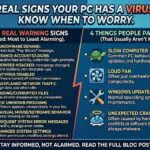
How to Tell If Your Computer Has a Virus: 10 Real Warning Signs
Pricing comparison
| Pricing | Kaspersky Plus (5 devices) | Bitdefender Total Security (5 devices) |
|---|---|---|
| Year 1 price | ~$35 (where available) | ~$40 |
| Renewal price | ~$55–70 | ~$70–90 |
| VPN included | ✅ Unlimited | ⚠️ 200MB/day only |
| Available in US | ❌ No | ✅ Yes |
| Money-back guarantee | 30 days | 30 days |
Who should choose which
The decision is effectively made for you. Kaspersky is no longer legally available for new purchases in the United States following the September 2024 ban. If you currently have Kaspersky installed, the US government advised users to transition to alternative products. Bitdefender Total Security is the most direct comparable replacement — similar detection rates, similar pricing, similar system footprint, with none of the complications.
No legal ban applies to personal use in these countries. However, several government cybersecurity agencies in Europe have issued advisories recommending caution. For government employees, contractors, or anyone handling sensitive professional data, the UK’s NCSC and equivalent agencies recommend avoiding Kaspersky. For personal home use on a PC used for browsing and home tasks, the practical risk is lower — but Bitdefender provides equivalent protection without any ownership concerns.
In regions where no government advisory applies and where Kaspersky’s Russian ownership is not a specific concern, Kaspersky Plus represents genuinely strong value — particularly for users who want an unlimited VPN included in their security subscription. The detection rates are comparable to Bitdefender and the price is typically lower. The ownership question is a factor each user should weigh according to their own risk assessment.
Bitdefender Total Security — comparable protection, available everywhere
For users who want the detection quality that Kaspersky was known for — without the US ban, ownership concerns, or government advisories — Bitdefender Total Security is the most direct equivalent. It matches Kaspersky score-for-score in independent lab testing, runs with similar system lightness, and is owned by a Romanian company with no equivalent geopolitical complications.
Affiliate disclosure: We earn a small commission at no extra cost to you. We only recommend tools we have researched and verified.
Frequently asked questions
Last Updated on May 26, 2026 by Security Guru Jay