An unpaid toll text scam is a fake text that says you owe a small toll and threatens a late fee unless you pay through a link. It is almost always fake: real toll agencies do not collect overdue tolls through a link in an unexpected text. Do not tap the link. Check your toll balance yourself, through your own toll account or the agency’s official site, and then report the text to 7726 and delete it.
This is smishing — SMS phishing, which means phishing delivered by text message. The text arrives out of nowhere, names a toll service you may recognise, and gives you a deadline. It works because the amount looks small and the threat looks official. The Federal Trade Commission reported that Americans lost $470 million to scams that started with a text in 2024, about five times the 2020 figure, and unpaid toll notices were among the five most-reported types of text scam that year.
The FBI’s Internet Crime Complaint Center counted 59,271 “Toll Scams” complaints in its 2024 Internet Crime Report, with $129,624 in reported losses. That small loss figure is worth reading carefully: it means most people who reported the text spotted it and lost nothing. The complaints count attempts, not real damage — and the attempt is the whole scam.
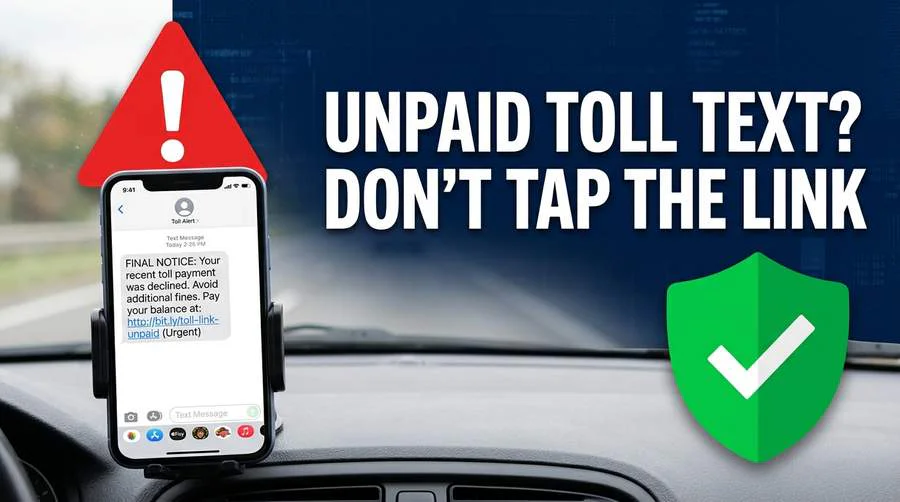
What does an unpaid toll text scam look like?
The message follows the same pattern almost every time. It says you owe money for an unpaid toll, shows a dollar amount, warns of a late fee, and gives you a link to pay. The FBI’s public-service announcement from 12 April 2024 quoted a real example of the text:
“(State Toll Service Name): We’ve noticed an outstanding toll amount of $12.51 on your record. To avoid a late fee of $50.00, visit https://myturnpiketollservices.com to settle your balance.”
The amount is deliberately small — small enough that paying feels easier than checking. The toll service named in the text changes from state to state: E-ZPass, SunPass, FasTrak, TxTag, Peach Pass, and I-PASS have all appeared in these messages. The FBI said that since early March 2024 it had received over 2,000 complaints about this exact pattern from at least three states, and warned that the scam may be moving state to state. That is why the text may name your own state’s toll service even if you have never driven through a toll.
Why is this text almost always a scam?
Because of one simple rule: real toll agencies do not collect overdue tolls through a link in an unexpected text. Real unpaid-toll bills mostly come by mail, and a real balance is checked by logging in to your own toll account or the agency’s official site yourself — never by following a link someone texted you.
The Federal Trade Commission said the same thing in the FTC’s January 2025 alert: scammers are pretending to be tolling agencies from coast to coast, and the text is a phishing scam. The link leads to a page asking for your bank or credit card information. The FTC also warned that clicking can expose personal information such as a driver’s license number, which can lead to identity theft — so the risk is not only the few dollars in the text.
A DMV text scam works the same way. Whether the message arrives as an E-ZPass text scam, a DMV text scam, or a fake toll text about a ticket or a licence problem, the test is identical: did it arrive as an unexpected text with a payment link? If yes, treat it as fake until you have checked it yourself through a channel you trust.
How do I check if I really owe a toll — in 60 seconds?
Do this in order, and do not touch the link at any point.
| Step | What to do | Why it works |
|---|---|---|
| 1. Stop | Do not tap the link and do not reply to the text — not even to say “stop” or ask who this is. | Replying tells the sender your number is active, and the link is the trap itself. |
| 2. Open your own account | Type your toll agency’s official website address yourself, or open the agency’s app you already have installed, and log in. | You reach the real agency, not a copy of its payment page. |
| 3. Check the balance | Look at your toll balance and any unpaid notices inside your account. | If nothing is due, the text was fake. If something is due, pay it inside your own account. |
| 4. Still unsure? | Call the toll service’s customer service number — the one on its official website, not the number in the text. | The FBI’s advice is to use a phone number you know is real, not the information from the text. |
| 5. Report and delete | Use your phone’s “report junk” option, or forward the text to 7726 (SPAM), then delete it. | 7726 spells SPAM on a phone keypad, and forwarding the text there reports it to your wireless carrier. |
If you have no toll account at all — no transponder, no registered plate — there is nothing to check, and the text is fake. You cannot owe a toll to an agency you have never used.
Real toll notice vs fake toll text — how to tell them apart
| Sign | Real toll notice | Fake toll text |
|---|---|---|
| How it arrives | Mostly by mail; or as a notice inside your own toll account or app. | An unexpected text message with a payment link. |
| The amount | Matches a trip you actually made, shown in your account. | A small, round-looking amount — $12.51 in the FBI’s example — meant to look too small to question. |
| The deadline | Normal billing terms, stated on the bill or in your account. | Pay now or face a $50 late fee, a suspended licence, or collections. |
| How you pay | By logging in to your own account or the agency’s official site yourself. | By tapping the link in the text and entering card details on the page it opens. |
| What it asks for | Payment through your existing account. | Bank or credit card information — and sometimes personal information such as a driver’s license number. |
What should I do with the text?
Do not click links in, or respond to, unexpected texts — that is the FTC’s advice, and it is the whole response to any unpaid toll text scam in one sentence. Then do three small things. First, use your phone’s “report junk” option, or forward the text to 7726 (SPAM). Second, delete the text. Third, if you want the attempt on record, file a report at ReportFraud.ftc.gov, and file a complaint with the FBI’s Internet Crime Complaint Center at ic3.gov, including the phone number the text came from and the website listed in the text — that is what the FBI asks for in its announcement.
What if I already clicked the link or paid?
Act on the same day, in this order. First, secure your personal information and financial accounts: check your bank and card statements for charges you do not recognise, and dispute any unfamiliar charges with your bank or card issuer. Second, if you entered a password anywhere, change it — and change it anywhere else you used the same one. Third, read our guide on what to do if you already clicked a link, which walks through the same steps in detail.
Do not expect the money to come back on its own, and do not trust anyone who contacts you offering to recover it — that is usually a second scam aimed at the same victim. Your bank or card issuer is the only party that can dispute a charge.
Same trick, different message
The unpaid toll text scam is one version of a trick that keeps changing its costume. The same urgency-plus-link pattern shows up as the fake ‘your computer is infected’ popup that tells you to call a number immediately, and as scam messages on WhatsApp that push you to tap a link before you have time to think. The message changes; the test never does. If an unexpected message demands money through its own link, check it yourself through a channel you chose — never through the message.
Frequently asked questions
Is an unpaid toll text ever real?
Almost never. Real toll agencies do not collect overdue tolls through a link in an unexpected text, and real unpaid-toll bills mostly come by mail. If you think you might owe something, check your balance by logging in to your own toll account or the agency’s official site yourself — never through the link in the text.
What is smishing?
Smishing is SMS phishing: phishing delivered by text message instead of email. The text pretends to be from a trusted organisation — in this case a toll service — and its link leads to a fake page designed to steal bank or card details, or personal information such as a driver’s license number.
I never drive on toll roads. Why did I get the text?
Because the texts are sent in bulk, not to real toll users. The FBI received over 2,000 complaints about this pattern in about five weeks from early March 2024, from at least three states, and warned the scam may be moving state to state. The message names a toll service from your area so it looks plausible, whether or not you have ever used a toll road.
What does forwarding a text to 7726 do?
7726 spells SPAM on a phone keypad. Forwarding a suspicious text to 7726 reports it to your wireless carrier, which uses those reports to block similar messages. After forwarding, delete the text. You can also use your phone’s “report junk” option, and file a report at ReportFraud.ftc.gov.
I already clicked the link. What do I do now?
Secure your personal information and financial accounts first: check your bank and card statements for charges you do not recognise and dispute any unfamiliar charges with your bank or card issuer. If you entered a password, change it everywhere you used it. Then follow the steps in our guide on what to do if you already clicked a link.
I already paid. Can I get the money back?
There is no guarantee. Call your bank or card issuer right away, tell them what happened, and dispute the charge. The sooner you report it, the better your chances — but no one can promise a refund, and anyone who contacts you offering to recover the money for a fee is almost certainly running a second scam.
Is the DMV text scam the same thing?
Yes — it is the same trick with a different name on it. A DMV text scam claims you owe a ticket or a licence fee and must pay through a link, just as a fake toll text claims you owe a toll. The check is the same: do not tap the link, look up the agency yourself, and check your account through its official site or app.
Sources: FTC consumer alert, January 2025, “Got a text about unpaid tolls? It’s probably a scam”; FBI IC3 public-service announcement, 12 April 2024 (I-041224-PSA); FBI IC3 2024 Internet Crime Report; FTC Consumer Data Spotlight, April 2025, “Top text scams of 2024”.